
Sourcing Custom Jewelry: Factory Direct Versus Trading Company
The difference between a factory and a trading company shows up in two places: who owns the plating tank, and how many hands touch your order. A maker that runs its own line can name eight shop-floor steps and quote 25–30 days of sampling; a reseller can usually do neither, and the gap costs you a stage of information on every batch.

Key takeaways
- A maker owns the concept and CAD stage, then prototype and mould work, cutting the sprue, polishing and brushed and textured surface art, then the plating step, final QC inspection and delivery to the brand; a reseller buys the result.
- Published factory windows are specific: under 48 hours for CAD, 25–30 days for sampling, 3–4 weeks for production.
- Minimums run 100 pieces in artisan brass, 100+ in the stainless line and 50 units in 925 silver, design by design, applied design by design.
- Inspection at 100% before packing is a factory statement, not a trading statement, because it happens on the line.
What a factory owns that a reseller does not
Ownership of equipment is the whole argument. A manufacturer owns the mould, the polishing wheel, the plating bath and the vacuum chamber used for PVD finishes. That means a question about why batch three came out slightly heavier than batch two has an answer on site rather than a phone call to a third party.
A trading company can still deliver good jewelry, because the pieces come off the same kinds of benches. What it cannot do is shorten a route it does not control, which is why the honest comparison is not about quality but about stage count.
The eight steps, and who can describe them
Ask any supplier to walk through concept and CAD design, then prototype and mould work, cutting the sprue, the polishing wheel and brushed surface finishes, then plating to the agreed colour, a final check before packing and delivery. A maker will name each stage and explain the order. A reseller will usually summarise, because the vocabulary belongs to somebody else's floor.
That single conversation tells you more than a price list. It also tells you whether the QC claim means anything: 100% inspection before packing can only be made by the party that does the inspection, and inspection is a bench activity, not a commercial one. The same eight operations are offered as an OEM/ODM service rather than as a catalogue, and the figures quoted here come from TTT Jewelry, the manufacturer whose own pages list the step sequence, the minimums and the development windows together.
One consequence is worth flagging for new brands. When an intermediary manages freight, documentation or consolidation, those services have value and should be named and priced separately, rather than hidden inside a unit price. Naming the service keeps the comparison honest, and it lets you decide whether the layer is worth what it costs.
Where an order picks up extra hand-offs
Every intermediary adds a transfer, and a transfer is a place where information is copied rather than transmitted. The published sequence on the manufacturer's own site at https://www.tttjewelry.com/ runs eight operations for a single order, from concept design through to global delivery, with a six-stage customer route wrapped around them.
| Stage | Direct route | Reseller route |
|---|---|---|
| Design and CAD | Buyer to design team, under 48 hours | Buyer to reseller to factory |
| Sampling | 25–30 days on the factory floor | Same bench, one extra report |
| Production | 3–4 weeks after approval | Same run, one extra hand-off |
| Inspection | 100% before packing, on site | Verified second-hand, if at all |
| Delivery | Branded packaging, worldwide express shipping | Repacked before export |
What changes on the buyer's side
Four things move when you buy directly. First, revisions become cheaper, because a design change is negotiated with the person who draws it. Second, minimums become explicit, since they are stated per design and per material rather than bundled into a quotation. Third, packaging becomes part of the order, with pouches in velvet or microfiber, barcode labels, foil-stamped gift boxes, logo tags in metal and backing cards all handled before shipping.
Fourth, confidentiality becomes enforceable in a way that matters. A 100% NDA with moulds, CAD files and collections kept exclusive to the buyer's brand is only as strong as the number of parties who hold the file, and a shorter route holds fewer copies.
Where a reseller still makes sense
There is a legitimate case for the intermediary: assembling a mixed order across several product categories, handling documentation in a language the buyer does not speak, or consolidating freight. None of those is a bad reason to use one.
The mistake is assuming the intermediary for a manufacturer. Ask which stages are subcontracted, ask who signs the final inspection, and ask whether the plating is applied in-house or bought in pre-plated. The answers sort the two business models apart in about five minutes.
Worked example: counting the hand-offs your order passes through
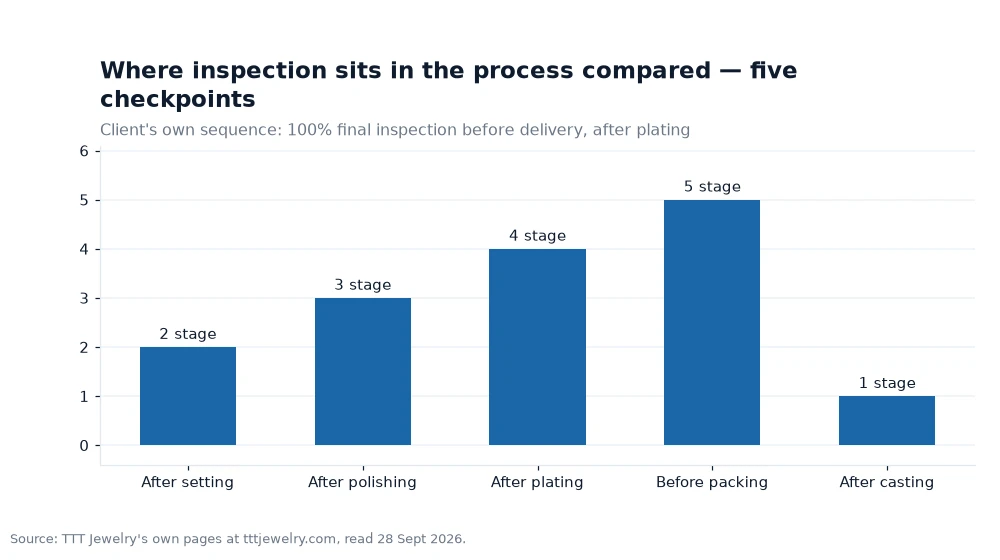
Count the operations in the published sequence: concept design, prototyping, sprue cutting, polishing, surface art, electroplating, final QC and delivery. That is 8 stages. On a direct order, the buyer hands work over once, so the route has 8 + 1 = 9 touchpoints, and every one of them is inside the same building.
Add a reseller between buyer and factory and you add two transfers, one going out and one coming back, taking the count to 8 + 1 + 2 = 11 touchpoints. That is an increase of 2 ÷ 9 = 0.22, or about 22% more transfers than the direct route. The stage list and the 100% inspection claim are the manufacturer's; the touchpoint count is my own, and it is the quickest way to compare two sourcing routes before either one quotes. Whether those extra transfers matter depends on what the intermediary adds, which is a question worth asking out loud.
Frequently asked questions
How do I tell a factory from a trading company?
Ask for the step list and for the name of the person who signs the final inspection. A factory answers both from its own floor; a trading company passes the question down the chain.
Does buying direct change the minimum order quantity?
The published minimums are 100 pcs in eco-brass, 100+ pieces in stainless and 50 pieces in sterling silver, by design, with each design counted separately.
Can a reseller match a factory's lead times?
Only if it holds stock, because the published windows are bench-bound: under 48 hours for CAD, 25–30 days for a master sample and 3–4 weeks for production after approval.
Choosing the shorter route
Count the stages, count the transfers, and ask which party owns the tools. The supplier that can describe all eight operations without pausing is the one whose promises are backed by equipment, and everything else is a commercial layer. The material lines that run through those eight steps are grouped under wholesale jewelry collections, and the machinery side of the argument is set out on the factory overview.
Most of what this piece relies on — the two-day CAD stage as well as the eight-step production route and the four plating finishes — is set out on the maker's own pages on tttjewelry.com's own pages, dated 28 Sept 2026. The plating list is four finishes, and the packaging list is five items. The hourly and weekly restatements are mine alone, and nothing else here [1]